

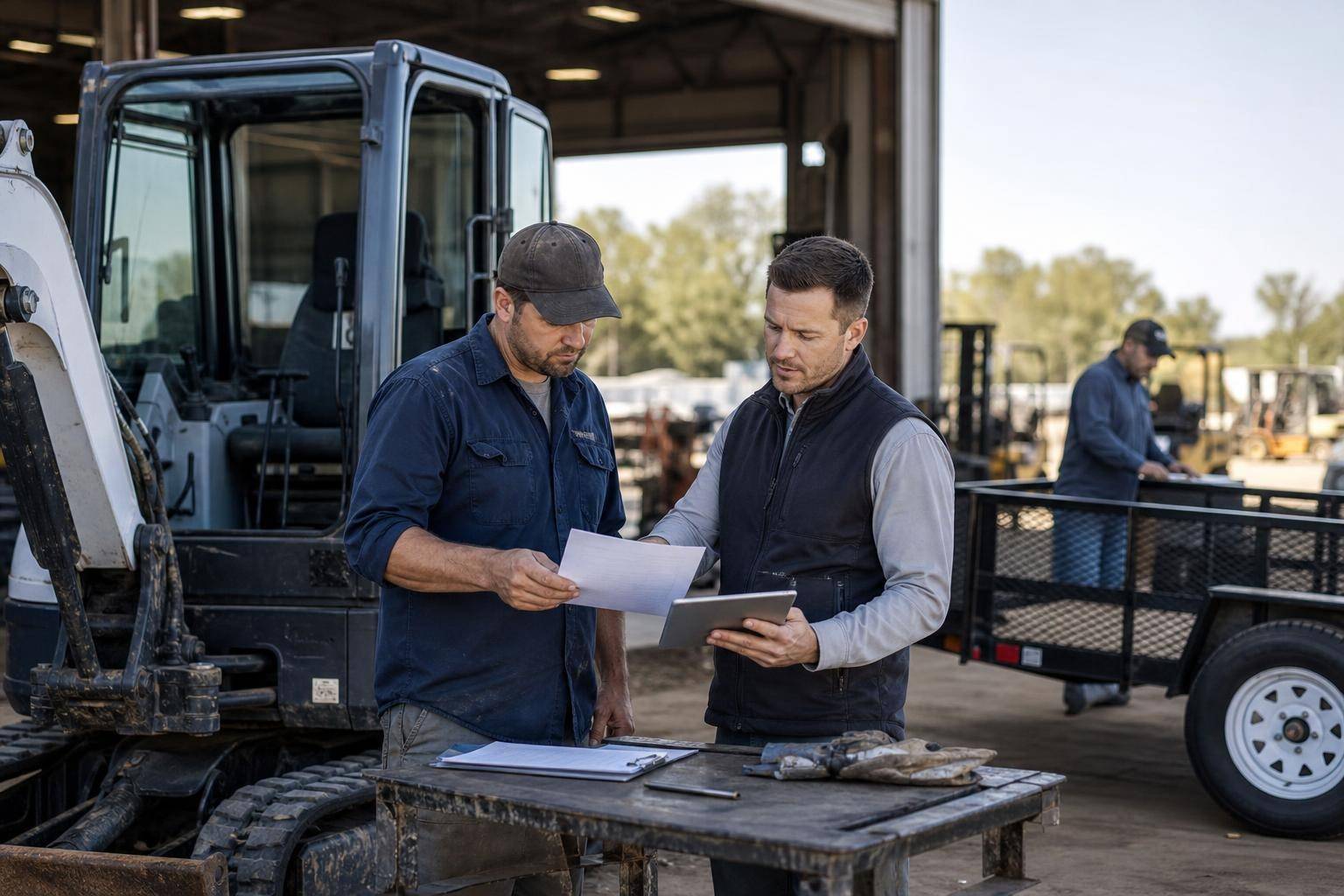
Financing used equipment from a private seller or auction may be possible, but approval for your business is only part of the equation. The specific machine, the seller’s authority, the paperwork, any payoff issue, and the payment deadline also have to work.
Table of ContentsJump to a section
- Used Equipment Financing Private Seller in Practice
- Private Seller vs. Auction vs. Dealer: A Financing-Readiness Comparison
- Start With an Identifiable, Reviewable Asset
- Build a Usable Document Packet
- Verify the Seller, Any Payoff, and Potential Claims
- Inspect Before You Commit
- Set a Bid Ceiling Using the All-In Cost
- Auction Purchases Need a Timing Plan Before the Bid
- Private-Seller Equipment Financing: A Safer Closing Sequence
- Compare Funding Paths by the Whole Transaction
- Keep the Closing File
- Before You Bid, Sign, or Wire
- Frequently Asked Questions
- Sources
That distinction matters before you sign an agreement, send a deposit, or place a binding auction bid. A low-priced excavator can become an unworkable purchase if its serial number is inconsistent, the seller cannot support a payoff arrangement, or the auction requires payment before funding can be completed.
Start with the asset and transaction details, then speak with a prospective funding provider. For broader guidance on pre-owned assets, see Mulah’s used equipment financing and leasing guide.
Used Equipment Financing Private Seller in Practice
Dealers often have a formal invoice process and are accustomed to working with third-party payments. A private seller may not. At an auction, the buyer may have only a short window to pay, remove the equipment, and avoid storage charges.
Before committing, find out whether the prospective provider can review the asset, accept the available documents, pay the required party, and work within the sale timeline. Financing availability does not automatically make every seller or auction purchase feasible.
Private Seller vs. Auction vs. Dealer: A Financing-Readiness Comparison
| Issue | Dealer | Private seller | Auction |
|---|---|---|---|
| Source documents | May provide a quote or invoice | Buyer may need to assemble a purchase agreement and bill of sale | Listing, bidder record, invoice, and sale terms |
| Equipment identification | Often appears in dealer records | Match the serial number or VIN across all records | Match the lot description, machine, and invoice |
| Seller authority | Usually a business counterparty | Confirm the legal seller and authority to transfer the asset | Review the auctioneer’s agency and transfer terms |
| Lien or title work | May be more structured, but still transaction-specific | May require payoff, release, and record review | Confirm what the sale terms say, if anything, about title or liens |
| Inspection access | May be available by arrangement | Depends on the seller | May be limited to a preview period or site rules |
| Condition recourse | Depends on the contract or warranty | Depends on the negotiated agreement | Often limited by as-is, where-is terms |
| Payment timing | May be coordinated with closing | Can be negotiated | Often fixed and potentially fast |
| Fees and removal | Quote-specific | Allocate loading and delivery duties in writing | Buyer may face premiums, removal, pickup, and storage rules |
| Common friction | Asset value, age, and business qualification | Incomplete records or unresolved claims | Short deadlines and limited condition recourse |
Auction terms vary sharply. Ritchie Bros., for example, states that items are sold “as is, where is” and publishes its U.S. payment rules. One indexed Taylor & Martin sale required full payment within 24 hours and included a buyer’s premium. Neither example sets an industry standard. The terms for the particular sale and lot control.
Review Ritchie Bros. payment information and the Taylor & Martin sale terms before assuming an auction timeline can accommodate financing.
Start With an Identifiable, Reviewable Asset
Gather the make, model, model year when relevant, serial number or VIN, hours or mileage, attachments, configuration, location, photographs, and maintenance records. Also collect the proposed price, seller details, and a plain description of what is included.
Three identifiers serve different purposes. The serial number or VIN identifies the equipment. The seller’s exact legal name identifies the person or entity claiming to transfer it. A title or registration record can matter for certain trucks, trailers, and other titled assets, but ordinary machinery may not have one.
Check the serial number on the machine plate against the listing, inspection report, purchase agreement, invoice, and insurance request. If the model year, serial number, or configuration differs between records, pause the transaction until the discrepancy is explained and corrected.
Accurate identification and seller authority matter in a financed transaction. Under the model UCC framework, enforceability of a security interest generally involves the debtor having rights in the collateral or power to transfer rights. State law and the transaction facts govern. See UCC § 9-203.
Build a Usable Document Packet
This is a practical preparation list, not a universal underwriting checklist. A provider may need more, less, or different information depending on the asset and transaction.
- Sale documents: A purchase agreement or bill of sale stating the parties, price, asset description, included attachments, deposit treatment, closing terms, and delivery duties.
- Asset records: Serial-number or VIN photographs, equipment photos, maintenance records, hours or mileage, and an inspection report when available.
- Seller and transfer records: The seller’s exact legal name, title assignment for a titled asset, and any known payoff or release information.
- Auction records: The lot page, sale terms, auction invoice, buyer’s premium, payment instructions, and pickup or removal requirements.
These records make the transaction easier to evaluate. They do not all answer the same question. A bill of sale records the agreed transfer. A payoff letter states what is needed to satisfy a particular obligation. A lien release or termination can address a secured party’s claim after payoff. None is a substitute for looking at the whole transaction.
Verify the Seller, Any Payoff, and Potential Claims
A seller’s statement that equipment is “free and clear” is not enough on its own. Ask what supports the statement, especially when the asset is expensive, titled, or subject to a known loan.
If the seller still owes money on the equipment, do not simply send the full purchase price on the expectation that the seller will pay its lender afterward. A more careful closing may use verified payoff instructions, a payment path acceptable to the parties, and evidence of the expected release or termination process. For a substantial or complicated deal, qualified legal counsel or an appropriate title or escrow professional can help structure the closing.
UCC Searches, Titles, and NMVTIS Answer Different Questions
A UCC search can be a useful diligence step. Under the model UCC, filing offices index records by debtor name. That is why the seller’s exact legal name matters. A search result is not an ownership certificate, proof of clear title, or a complete lien opinion.
Use the relevant state-level UCC and title-record procedures, then compare the results with the seller, the asset description, and the deal itself. UCC § 9-502 describes the contents of a financing statement, while UCC § 9-519 addresses indexing. When an identified secured obligation is paid, a payoff letter and release evidence may be important. See UCC § 9-513 for the model-law termination framework.
Trucks and trailers may also require title-transfer, registration, and state-agency review. For covered motor vehicles, an NMVTIS report can provide state-of-title information, title brands, odometer information, and certain theft, salvage, and total-loss information. It is not a database for ordinary untitled construction or industrial equipment, and it does not replace title review or inspection. The Department of Justice recommends using other sources and obtaining an independent inspection. See its NMVTIS explanation.
Inspect Before You Commit
Condition risk is often the largest unknown in an auction purchase. “As is, where is” language can leave the buyer responsible for repairs, loading, freight, and deployment after the sale. The Arizona Department of Transportation’s auction terms provide a public example of this buyer-beware approach.
When the price and technical risk justify it, arrange an independent inspection before bidding or closing. If testing is allowed, record operating tests, cold starts, leaks, wear points, controls, fault codes, hours or mileage, attachments, missing parts, and the serial-number plate.
Don’t treat listing photos, reported hours, or condition reports as warranties unless the contract expressly says otherwise. Price immediate repairs, insurance, loading, freight, installation, and downtime before deciding what the equipment is worth to your business.
Set a Bid Ceiling Using the All-In Cost
Your bid ceiling is not the amount of cash on hand or a possible financing amount. It is the hammer price left after you account for the costs required to acquire and deploy the equipment.
Use Mulah’s business funding calculator to model the broader capital need. Then confirm which costs, if any, a particular funding offer can include.
| Cost item | Confirmed | Estimated | Excluded from financing or buyer-paid cash |
|---|---|---|---|
| Listing price or hammer bid | |||
| Buyer’s premium | |||
| Taxes | |||
| Documentation or convenience fees | |||
| Loading, rigging, and removal | |||
| Freight | |||
| Insurance and inspection | |||
| Immediate repairs or parts | |||
| Installation | |||
| Permits or registration, where applicable | |||
| Downtime or working-capital reserve |
Buyer premiums, taxes, freight, repairs, deposits, installation, and reserves are not automatically included in equipment financing. Some costs may require cash. A business line of credit can be a separate option for eligible operating expenses such as repairs, transport, or liquidity needs, but it should not be assumed to solve an auction payment deadline.
Example: A contractor finds an excavator with a favorable hammer price. Once the sale-specific premium, taxes, loading, freight, insurance, immediate repairs, and installation are added, the apparent bargain may disappear. If payment is due before financing can realistically close, the purchase may not fit even if the machine is otherwise attractive.
Auction Purchases Need a Timing Plan Before the Bid
Read the lot page and terms before registering or bidding. Focus on the buyer’s premium, deposit, accepted payment method, payment deadline, pickup window, removal rules, and storage charges. Inspect the machine when possible, then provide the asset details, auction documents, all-in budget, and deadline to a prospective funding provider.
Ask whether the auction source and payee can be accommodated, what documentation may be needed, and whether the timing is realistic. An early conversation is not an approval. If there is no workable payment plan that your business can safely carry, don’t bid.
Private-Seller Equipment Financing: A Safer Closing Sequence
A negotiated sale gives the buyer more room to coordinate the transaction, but the basics still need to be settled before funds move. First, identify the asset and the seller’s exact legal name. Inspect the equipment and match its serial number across the machine, photographs, records, agreement, and insurance information.
Next, use a written agreement covering the price, included items, deposit, closing, delivery, and any payoff condition. Investigate known lien or title concerns through the appropriate state processes. If the seller has an outstanding payoff, obtain and verify the payment instructions before closing and coordinate the release evidence required for the deal.
Example: An operating company is selling a used excavator. The buyer reconciles the machine plate with the inspection report, purchase agreement, photographs, and insurance request. The seller discloses an outstanding payoff, so the buyer pauses closing until the payoff instructions and release evidence can be coordinated. That does not guarantee financing or clear title, but it is far safer than relying on a verbal assurance.
Compare Funding Paths by the Whole Transaction
Possible paths include secured equipment financing, a lease or finance agreement, an SBA-backed option for an eligible business, cash, seller financing, or separate working capital. The right choice depends on the asset, cash flow, collateral review, seller requirements, and deadline, not just the advertised payment.
Equipment financing may suit an identifiable business asset, subject to business and asset review. A lease can have different ownership, return, purchase, and end-of-term terms. Cash or seller financing may avoid a funding-timing mismatch, but can reduce liquidity or add seller-credit risk. Document seller-financing terms carefully.
SBA-backed financing may be available for eligible businesses and qualifying projects. SBA lender resources note that 504 financing can support major fixed assets, including machinery and equipment. Program and lender requirements still apply. Review the SBA lender resources and SOP 50 10.
Compare total cost, payment schedule, cash-flow effect, collateral and guaranty obligations, permitted use of funds, early-payoff provisions, and funding timing. Mulah’s equipment financing and leasing overview explains the broader options.
Keep the Closing File
Retain the purchase agreement or auction invoice, bill of sale, serial-number photos, title documents where relevant, payoff and release records, inspection report, transport records, insurance documents, and receipts for connected acquisition costs.
The IRS says basis is generally the amount paid for an asset and may include sales tax and other costs connected with the purchase. Basis affects depreciation and gain-or-loss calculations. See IRS Topic No. 703.
Tax treatment depends on the agreement and facts. The IRS notes that an arrangement treated as a conditional sales contract can be treated differently from a true lease. Ask a qualified tax professional about depreciation, expensing elections, sales or use tax, and lease-versus-sale treatment. See the IRS guidance on leases and conditional sales.
Before You Bid, Sign, or Wire
Make sure the serial number or VIN, model, configuration, and attachments match across the available records. Confirm the seller’s legal identity and authority to sell. Read every purchase or auction term, build an all-in budget, and settle known payoff, lien, title, or registration issues before or at closing.
You should also know who handles insurance, loading, transport, and installation. Most importantly, ask a prospective provider whether the asset, documents, payee, and deadline are compatible before your commitment becomes binding.
Walk away or get professional help if the seller name or asset identifiers do not reconcile, the seller cannot support an ownership or payoff explanation, the inspection changes the economics, or the payment deadline would force a cash-flow strain your business cannot absorb.
Once you have the asset details, seller or auction documents, all-in budget, and timeline available, you can start a Mulah business funding application. Submitting information does not guarantee approval, funding, pricing, eligible costs, or compatibility with an auction deadline.
Frequently Asked Questions
Can I finance used equipment bought from a private seller?
It may be possible. The business, asset, seller, documentation, condition, value, and provider policy can all affect the outcome. Contact a prospective provider before the purchase becomes binding.
What documents should I collect for a private-sale equipment purchase?
Start with a written agreement or bill of sale, detailed equipment description, serial-number or VIN photos, seller legal-name information, condition and inspection records, price and payoff details, and title or registration records when applicable.
Can a UCC search prove equipment is free and clear of liens?
No. A UCC search can identify filings indexed to a debtor name, but it is not proof of ownership or a complete lien opinion. Use it with seller verification, asset identification, title review where relevant, payoff information, and professional advice when warranted.
How does auction financing work when payment is due quickly?
Start the funding discussion before bidding. Share the auction terms, asset details, all-in budget, and deadline. If the timing cannot work, you need a safe alternative payment plan or should not bid.
What should I add to my maximum auction bid?
Include the buyer’s premium, taxes, fees, inspection, loading, rigging, removal, freight, insurance, repairs, installation, registration or permits when applicable, and an operating reserve.
Do I need a title to finance used commercial equipment?
Not every machine has a title. Titled trucks, trailers, and similar assets may require title-transfer and state-agency steps. Untitled machinery may instead be evaluated through transaction-specific records, including serial-number documentation, sale records, seller-authority evidence, and condition information.
Can NMVTIS be used for construction or industrial equipment?
NMVTIS applies to covered motor vehicles, not ordinary untitled construction or industrial machinery. For an eligible vehicle, it can complement title review and inspection but does not replace either.
What if the seller still owes money on the equipment?
Pause and get verified payoff information. The parties may need a closing sequence that directs funds appropriately and produces release evidence. Seek legal, title, or escrow guidance when the deal is material or complicated.
Sources
- Cornell Legal Information Institute, UCC § 9-203
- Cornell Legal Information Institute, UCC § 9-502, § 9-519, and § 9-513
- U.S. Department of Justice, Understanding an NMVTIS Vehicle History Report
- Ritchie Bros., Payments
- Taylor & Martin, Terms, Conditions & Payment Instructions
- Arizona Department of Transportation, Auction Terms and Conditions
- IRS Topic No. 703, Basis of Assets and Income & Expenses FAQ 7
- U.S. Small Business Administration, SBA Lender Resources and SOP 50 10, Lender and Development Company Loan Programs
Educational information only. Funding products, terms, costs, eligibility, and availability vary by applicant, provider, product, jurisdiction, and time. This article does not guarantee approval, funding, pricing, or a particular legal or tax outcome.

Jim M
Jim M contributes educational business funding content for Mulah.com. Articles are produced using Mulah's research, sourcing, fact-checking, and editorial quality process.
View author profile