

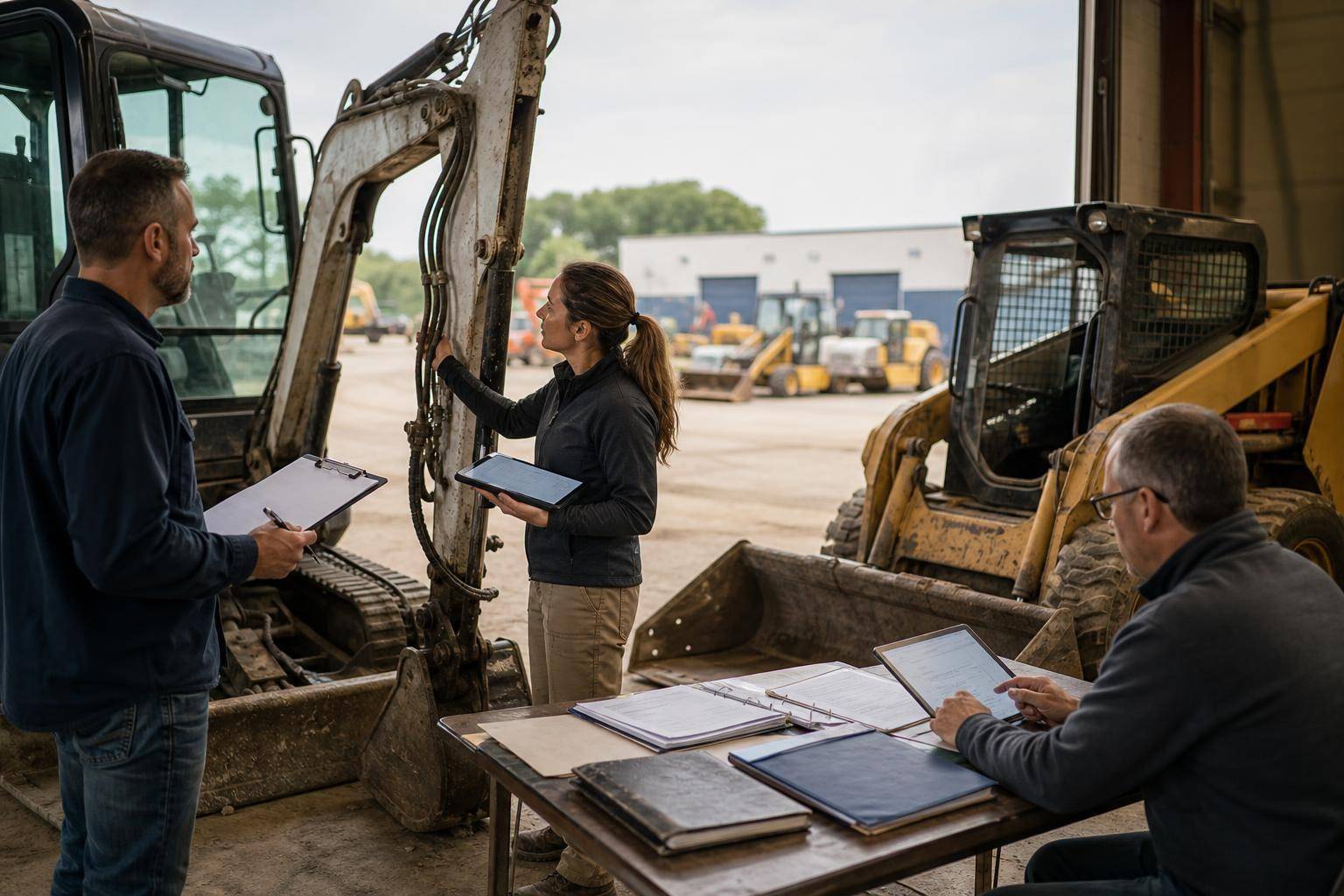
Used equipment financing requirements depend on the specific machine, seller, lender or lessor, and transaction structure—not on one universal checklist. For example, a provider may begin reviewing a common used asset purchased from a dealer with an itemized invoice, serial number, current photos, and seller details. Older, specialized, privately sold, installed, or auction-purchased assets may call for additional information, depending on the provider and circumstances.
Table of ContentsJump to a section
- Used Equipment Financing Requirements: What to Expect
- Five reviews that answer different questions
- Build an identity file for the exact unit
- Age and condition: useful life matters more than a cutoff
- When an inspection is worth arranging
- When value support or an appraisal may be needed
- Seller type changes the paperwork
- Resolve ownership and lien issues before funding
- Special cases that need a closer look
- A practical checklist from selection through closing
- Plan for the full deployment cost
- Questions to ask before committing
- Frequently asked questions
- Sources
The practical dividing line is this: a basic asset file may be enough for an initial provider review when the unit is easy to identify and price. Expect closer questions when condition is unclear, records are thin, the price is hard to support, ownership is unresolved, or the equipment will be difficult to resell or move.
Before making a nonrefundable deposit, assemble the file for the exact unit. That can help a lender assess collateral, but it can also help you spot repair, delivery, lien, and installation risks that are yours to manage as the buyer.
Used Equipment Financing Requirements: What to Expect
Model year matters, but it rarely tells the whole story. An older excavator with service records, a standard configuration, and an active resale market can be easier to assess than a newer custom machine with proprietary controls and limited buyer demand.
Depending on the provider and transaction, a review may cover the unit’s identity, operating hours or mileage, maintenance and rebuild history, remaining useful life, marketability, purchase-price support, seller identity, location, and ownership or lien issues. The proposed financing term and borrower file may also affect the review.
Government programs illustrate why there is no single federal or industry-wide checklist identified in the cited materials. USDA guaranteed-loan guidance addresses cost support, appraisal-based value in some circumstances, and additional discounting for used or specialized equipment. Those are program rules, not requirements for every commercial lender or lessor. USDA RD Instruction 5001 SBA programs likewise operate under their own program policies and collateral frameworks. SBA SOP 50 10 lender program policies | SBA lender program overview
Five reviews that answer different questions
Inspection, valuation, appraisal, and lender review are often used interchangeably. They should not be. Each addresses a different risk, and one report does not automatically substitute for another.
| Review | Primary question | Possible evidence | What it does not establish |
|---|---|---|---|
| Buyer due diligence | Is this asset a sensible purchase for the business? | Test run, technician review, repair estimate | Lender approval, clear ownership, or collateral value |
| Lender asset review | Can the proposed collateral be identified and reasonably assessed? | Invoice, photos, serial number, location, seller details | That the unit will work reliably in your operation |
| Technical or mechanical inspection | What condition and operating status were observed? | Inspection report, diagnostics, meter reading, test notes | Clear title, lien status, or a value conclusion |
| Valuation | Is the price or collateral value reasonably supported? | Comparables, dealer or broker opinion, internal analysis | A formal appraisal, unless the report is represented as one |
| Formal appraisal | What value conclusion follows a defined appraisal assignment? | Appraisal report with stated scope and assumptions | Guaranteed functionality or clear ownership |
A buyer’s inspection may show that a machine runs, but it does not show that the seller has authority to sell it. A lender’s value review may support a collateral decision, but it does not tell you whether the machine suits your production requirements.
USPAP is the professional standards framework used across appraisal disciplines, including personal property. If a true appraisal is requested, ask about the scope, report format, timing, intended user, and whether the appraiser will personally observe the equipment. A dealer opinion, lender analysis, or inspection report is not automatically an appraisal. USPAP overview | Appraisal Foundation guidance for practicing appraisers
Build an identity file for the exact unit
Make sure the quote, purchase agreement, photos, insurance information, and financing request all describe the same piece of equipment. A missing model suffix, unreadable serial number, omitted attachment, or seller-name mismatch can slow a transaction for a reason.
- Make, model, model year, serial number, or VIN
- Configuration, options, attachments, tooling, accessories, and included software
- Hour-meter, odometer, or cycle-count reading, preferably with a current photo
- Current photos of the unit, identification plate, and visible wear areas
- Operating location, delivery destination, and access contact
- Seller’s legal name, contact information, and itemized quote or purchase agreement
- Available maintenance, repair, rebuild, calibration, warranty, and service records
If an invoice lists a model but no serial number, get a photograph of the identification plate and ask the seller to revise the purchase documents. That simple fix can prevent a later mismatch in insurance, closing, or collateral records.
Precise names and descriptions can also matter in financing records. For ordinary Article 9 financing statements, the Uniform Commercial Code identifies the debtor, secured party, and covered collateral as core elements. State enactments and filing rules vary. UCC § 9-502
Age and condition: useful life matters more than a cutoff
The cited materials do not identify a single federal or industry-wide maximum age, hour, or mileage limit for used equipment financing. Individual lenders, lessors, government programs, asset types, and transactions may set their own age, condition, inspection, or documentation criteria. A more useful question is whether the asset’s condition, likely remaining life, and resale market fit the requested structure.
A high-hour unit can still have understandable value when maintenance is documented and parts support remains available. A newer machine can present more uncertainty when it has obsolete controls, locked software, an unusual configuration, or a narrow resale market.
For a commonly traded dealer-sold excavator, an itemized invoice, serial number, hour-meter photo, service history, and dealer contact may be a useful starting file for a provider review. More evidence may still be requested based on the asset and transaction. Businesses planning around job-site equipment can also review Mulah’s heavy equipment financing guide.
When an inspection is worth arranging
Photos and service records help explain a unit’s history. They are not a substitute for an independent condition assessment when a major repair, safety issue, or period of downtime could materially affect the business.
As buyer due diligence, an independent technical or mechanical inspection may be sensible for older, heavily used, rebuilt, specialized, as-is, or production-critical equipment. Whether a lender requests one is provider- and transaction-specific. Choose someone who knows the asset type. A general mechanic may not be the right person to assess a CNC controller, calibration system, medical component, or specialized production line.
For buyer and lender review purposes, consider asking that an inspection report identify the equipment by serial number, describe its scope and limits, record visible deficiencies, and note any test run or diagnostic work. A photo-only review has obvious limits compared with an onsite assessment.
Federal Reserve examination material illustrates that documentation and inspection reports can be reviewed in particular bank supervisory contexts, including larger or troubled-borrower and farm-lending contexts. It does not establish a used-equipment inspection requirement for every financing transaction. Federal Reserve Commercial Bank Examination Manual, Section 2000
A used CNC machining center often requires planning beyond the base machine price: controller and software status, tooling, maintenance or rebuild invoices, power and site requirements, rigging, installation, and acceptance testing. See Mulah’s CNC machine shop equipment financing guide for related planning considerations.
When value support or an appraisal may be needed
A seller invoice documents the proposed purchase price. It does not independently prove fair market value, functionality, clear ownership, or the absence of liens.
Price support may come from recent comparable sales or listings, a dealer or broker opinion, a lender’s internal review, an independent valuation report, or a formal appraisal. Confirm what the lender actually needs before paying for a report. A report ordered for your own planning may not meet the lender’s provider, timing, scope, or reliance requirements.
Depending on the provider and transaction, stronger value support may be useful when the equipment is thinly traded, unusually configured, difficult to inspect, older with limited records, or priced above available market evidence. It can also be relevant in related-party purchases, refinancing, and sale-leaseback transactions.
If the seller’s price is above the comparables, document the reason. Verified rebuild work, included attachments, transferable warranty coverage, calibration records, installation, or a scarce configuration may explain the difference. The lender may still reach its own value conclusion.
Seller type changes the paperwork
A dealer, auction house, private seller, affiliate, and out-of-state seller create different practical questions.
- Dealer: Confirm the legal seller name, itemized quote, exact unit, included accessories, warranty terms, and delivery responsibilities.
- Auction: Clarify preview or test-run access, as-is terms, buyer’s premium, payment and removal deadlines, freight, and any title process. Build those costs and deadlines into the financing plan before bidding.
- Private party: Focus on seller authority, bill-of-sale details, independently documented condition, payoff instructions, lien-release timing, and title transfer where applicable.
- Related party or affiliate: Be prepared to support ownership, price, transaction rationale, and arm’s-length documentation.
- Out of state: Confirm location, inspection access, pickup responsibility, transit insurance, and relevant registration, title, or record-search steps.
For a significant or complex purchase, a buyer may want the agreement conditioned on financing, a satisfactory inspection when appropriate, and documented lien payoff or title transfer. Local legal review can be appropriate before signing a binding agreement.
Resolve ownership and lien issues before funding
Condition and value are separate from ownership. An invoice or bill of sale records a claimed transaction, but it does not by itself prove that the seller owns the asset free of claims or has authority to transfer it.
Titled vehicles and similar assets can involve state-specific title and registration procedures. For non-titled equipment, the appropriate ownership and lien review can depend on the asset, parties, and states involved. Installed equipment can also raise questions about real-property interests and legal classification that may warrant local legal or title guidance.
A UCC search is not a national lien-clearance certificate. Official state systems may offer debtor-name or file-number searches and certified results, but the relevant state, title system, filing office, and asset type determine the appropriate search path. The right search path may also require attention to records beyond a particular state’s UCC index. Example: Illinois Secretary of State UCC search system
If there is an existing lien, get written payoff instructions and establish when the release will be delivered. A verbal assurance that the seller will pay off debt is not a closing process. Use qualified local legal, title, or closing professionals for complex lien, cross-state, title, or installed-equipment questions.
Special cases that need a closer look
Installed equipment can be expensive to remove and may affect the facility when disconnected. Discuss site access, removal rights, landlord or property-owner interests, utility connections, and installation contracts before treating it like portable equipment.
For diagnostic, test, or calibration equipment, collect service and calibration records, accessory lists, software or license-transfer information, operational-status evidence, and manufacturer support details. If the equipment is on an active job site or at a customer facility, confirm who can provide inspection access and how the specific unit will be identified.
A practical checklist from selection through closing
Before a deposit
- Identify the exact unit and obtain an itemized quote that separates equipment from add-on costs.
- Collect serial or VIN details, photos, location, seller legal name, and available service records.
- Decide whether a test run, technical inspection, or specialist review is warranted.
- Ask about ownership, liens, payoff process, and title records when relevant.
- Ask the lender what it needs before ordering a paid inspection or appraisal.
After conditional approval
- Provide requested condition, valuation, ownership, insurance, delivery, or acceptance evidence.
- Resolve inconsistencies in price, serial number, seller name, attachments, location, or condition.
- Confirm any funding conditions tied to payoff, release, delivery, title transfer, or installation.
- Review the final equipment description and funded cost categories before signing.
After closing
Retain invoices, bills of sale, delivery and acceptance records, warranties, inspection reports, insurance records, and repair or improvement documentation. The IRS recommends keeping records that show how and when business assets were acquired, their cost, improvements, use, and disposition. Those tax-recordkeeping obligations are separate from financing, but orderly records can make later asset questions easier to answer. IRS Publication 583 | IRS Publication 946
Asset dossier template
A shared folder or spreadsheet works well. Include these headings:
- Transaction: purchase price, deposit, seller channel, expected closing, and delivery date
- Asset identity: make, model, year, serial or VIN, meter reading, configuration, and attachments
- Location and condition: addresses, access contact, photos, service history, repairs, rebuilds, test notes, and inspection results
- Value and ownership: itemized invoice, comparables, appraisal if requested, seller details, payoff letters, title records, and lien releases
- Project costs and closing: taxes, freight, rigging, installation, commissioning, repairs, calibration, software, training, warranties, insurance, delivery receipt, and acceptance record
Keep borrower-level documents separate from this asset file. Mulah’s business funding documents checklist covers that side of preparation. A complete dossier can reduce avoidable follow-up, but it does not guarantee approval or a particular financing structure.
Plan for the full deployment cost
The invoice price may be only part of the capital need. Separate the equipment price from attachments, taxes, buyer’s premium, freight, rigging, installation, commissioning, repairs, calibration, software, training, warranties, and working-capital needs.
A low purchase price can become an expensive project if transport, repairs, site preparation, or ramp-up costs are missed. Mulah’s business funding calculator can help model the broader project need. Repayment planning should reflect actual cash flow and the time required to put the asset into service.
Questions to ask before committing
- Can you review the quote and basic asset details before I make a nonrefundable deposit?
- Do you need photos, service records, a test run, an inspection, a valuation, or a formal appraisal?
- If a third-party report is needed, who chooses and pays the provider? Are fees refundable?
- What report scope, timing, format, and reliance language do you require?
- What payoff, lien-release, title, delivery, or acceptance evidence must be resolved before funding?
- Are auction, private-party, related-party, installed, or out-of-state purchases handled differently?
If you have an itemized quote or purchase agreement, asset identity details, pricing, location, and available condition and ownership records, you can explore equipment financing and leasing options through Mulah. A submission may help identify potential options. Eligibility, documentation, and actual terms depend on the applicant, asset, transaction, state, and available provider.
For separate guidance where business or personal credit is imperfect, see Mulah’s resource on used equipment financing and leasing with imperfect credit.
Frequently Asked Questions
Is there a maximum age for used equipment financing?
The cited materials do not establish a single federal or industry-wide cutoff. Individual lenders, lessors, programs, asset types, and transactions may use their own criteria. Age may be considered alongside condition, hours or mileage, maintenance, technology, marketability, useful life, seller channel, proposed term, and borrower repayment capacity.
Do all used-equipment financing applications need an inspection?
No single universal inspection requirement is identified in the cited materials. A provider may set its own requirements based on the asset and transaction. An independent inspection can still be prudent buyer due diligence when technical complexity, repair exposure, safety concerns, or downtime risk are substantial.
Can auction or private-party equipment be financed?
Possibly, depending on the provider and transaction. Auction purchases bring timing, removal, premium, freight, and as-is considerations. Private-party purchases can call for more attention to seller authority, condition evidence, payoff instructions, lien releases, and title transfer where applicable.
Who pays for an inspection or appraisal?
That depends on the transaction, lender, and service-provider agreement. Confirm the cost, payment timing, refundability, provider selection, required scope, and who may rely on the report before authorizing work.
Sources
- USDA Rural Development, RD Instruction 5001 Guaranteed Loan
- U.S. Small Business Administration, Lender and Development Company Loan Programs (SOP 50 10)
- U.S. Small Business Administration, Partnering with SBA loan programs
- The Appraisal Foundation, USPAP
- The Appraisal Foundation, Practicing Appraisers
- Legal Information Institute, UCC § 9-502
- Illinois Secretary of State, UCC Search
- Federal Reserve, Commercial Bank Examination Manual, Section 2000
- Internal Revenue Service, Publication 583: Starting a Business and Keeping Records
- Internal Revenue Service, Publication 946: How To Depreciate Property
Educational information only. Funding products, terms, costs, eligibility, and availability vary by applicant, provider, product, jurisdiction, and time. This article is not legal, tax, title, appraisal, engineering, or insurance advice and does not guarantee approval, funding, pricing, or any particular transaction structure. Use qualified local professionals for complex title, lien, cross-state, installed-equipment, insurance, or technical-condition matters.

Jim M
Jim M contributes educational business funding content for Mulah.com. Articles are produced using Mulah's research, sourcing, fact-checking, and editorial quality process.
View author profile