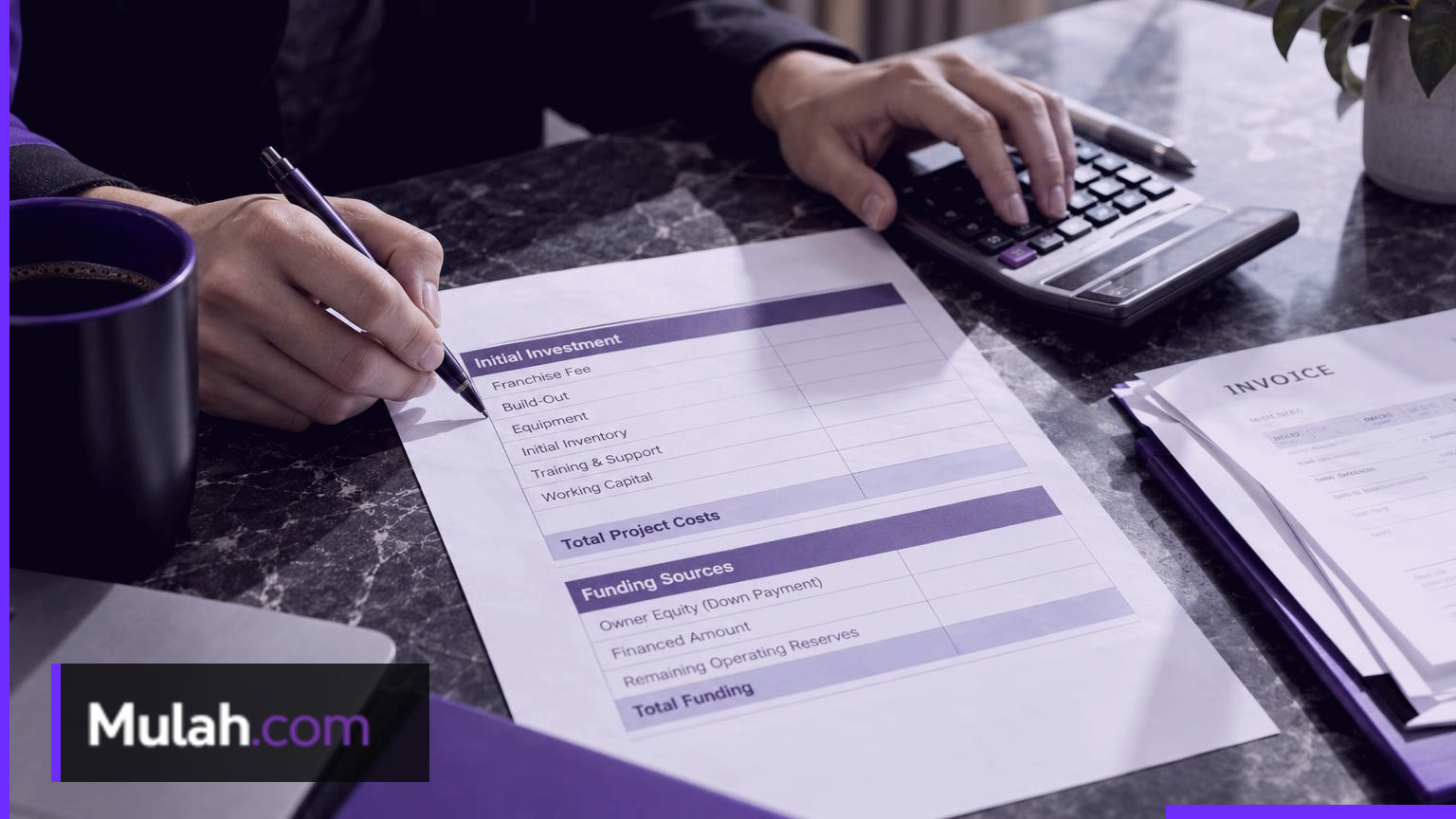
Franchise financing down payment requirements depend on the financing program, the total project cost, and the strength of the proposed business. The franchise fee alone does not tell you how much cash you need. A sound funding plan separates lender-required equity from closing expenses, opening cash, and the reserves that keep the location operating while sales build.
Required equityProgram and lender dependentAn advertised minimum is not a commitment. The lender assesses the transaction, management experience, repayment capacity, and proposed capital structure before setting its requirement.
Calculation baseTotal project cost mattersThe equity percentage may apply to more than the purchase price. Eligible construction, equipment, fees, and initial working capital can affect the project total.
Cash availabilityContribution is not the whole budgetMoney used for the equity injection is no longer available for payroll or rent. Keep lender-required liquidity and practical operating reserves separate from the contribution.
Source documentationTrace the moneyExpect questions about where the funds originated, whose account holds them, and whether another repayment obligation is attached. Large recent transfers usually need supporting records.
What business owners should know
What franchise financing down payment requirements actually measure
In franchise financing, a down payment usually means the owner's equity contribution to the project. It is not simply a deposit paid to the franchisor. A lender wants the owner to invest capital that stays at risk in the business, reducing the amount financed and giving the operation a stronger balance sheet. For a new location, the project might include the franchise fee, leasehold improvements, equipment, opening inventory, professional costs, and initial working capital. For an acquisition, the purchase price may be the largest expense, but transaction costs and operating cash still matter. The lender decides which costs belong in its financing calculation.
For SBA 7(a) loans, current program rules generally require at least a 10% equity injection for startups and complete changes of ownership. That floor does not make 10% sufficient for every applicant. A lender can require a larger contribution because of projected cash flow, limited operating experience, construction risk, or other weaknesses. Conventional franchise loans have no single universal down payment rule. An equipment lender might finance a substantial portion of eligible equipment while leaving the borrower responsible for deposits, installation, and costs outside the equipment package. Ask for the requirement for your specific transaction, not a percentage from a different franchise or financing product.
Mulah is a business-funding marketplace that helps owners understand potential financing options and prepare a clearer funding request. The useful question is not just how little cash a financing source might accept. It is how much debt the location can support after paying rent, labor, royalties, and other operating expenses. A lower contribution preserves cash initially but increases the financed balance and usually the payment burden. A larger contribution reduces debt but can leave the owner short of operating liquidity. The right structure must survive both the closing date and the slower months that can follow.
What this means in practice
The down payment, franchise fee, and liquidity requirement are different
A franchise fee buys rights and services under the franchise agreement. It is a use of money, not automatically the amount of equity a lender requires. If you pay the fee from your own funds before closing, a lender may count that payment toward your contribution when the expense is eligible and properly documented. Do not assume it will. Ask about acceptable timing and records before paying a nonrefundable amount. An invoice alone may not be enough; the lender may also need a cleared payment and bank statements connecting the payment to an acceptable source.
The franchisor's financial qualifications are another separate test. A brand may require a particular net worth or level of liquid assets before accepting a candidate. Those standards do not replace lender underwriting. Home equity, retirement savings, and ownership in another business can increase net worth without providing readily available closing cash. Likewise, a franchisor's liquid-capital threshold may not cover the equity contribution plus the reserves a lender expects you to retain. Read the franchise disclosure document's fee and estimated-investment information, particularly Items 5 through 7, alongside actual site-specific bids. A broad investment range is not a construction contract or a funding commitment.
Consider an illustrative project costing $500,000, including eligible opening working capital. If the lender requires 15% owner equity, the contribution is $75,000 and the proposed financing is $425,000, assuming the remaining costs are financeable. If you also need $20,000 for costs outside the financed project and want $40,000 left as additional reserves, your cash planning target becomes $135,000. That does not mean the lender's down payment is 27%. It means three different needs require cash. Keep the categories distinct so a deposit, closing charge, or reserve balance is not counted twice.
Where timing matters
Build the cash requirement around the opening timeline
Cash leaves the business at different points, often well before loan proceeds become available. Map each expense to its due date and funding source. This is especially important when lease obligations begin before construction is finished or when financing reimburses approved expenses only after documentation is submitted.
Commitment
Before signing the franchise agreement
Get the estimated investment range, required deposits, and refund terms in writing. Ask which payments can wait until financing is committed and which cannot. Signing a franchise agreement or paying a fee does not obligate a lender to fund the project. If financing is still uncertain, understand the amount you could lose and have an attorney assess any financing contingency.
Site
When the location becomes a real budget
Replace general buildout allowances with contractor bids, equipment quotes, landlord work obligations, and a realistic opening schedule. Tenant improvement allowances can reduce your ultimate cost but may be reimbursed only after work is completed. That timing can create a cash gap. Include utility deposits, permits, freight, and installation where applicable rather than treating the equipment price as the installed cost.
Underwriting
When the lender sets the contribution
Ask for the project-cost calculation and equity requirement in dollars. Resolve how previously paid expenses, investor contributions, and any seller financing will be treated. If the lender excludes a cost from the loan, determine whether it still belongs in the equity calculation or must be paid separately. Keep a single sources-and-uses schedule so the loan request, franchise budget, and bank statements tell the same story.
Closing
When the cash must be verified
The lender may require proof that equity has been contributed before or alongside disbursement. Preserve payment receipts and avoid moving funds through multiple accounts without a clear reason. A last-minute transfer can delay verification even when the money is legitimate. Ask how closing costs, prepaid expenses, and outstanding vendor balances will be handled so the final cash requirement is not a surprise.
Opening
When operating reserves take over
Forecast cash by week through opening and the early operating period. Payroll, rent, insurance, royalties, and required advertising charges may arrive before sales stabilize. Delayed inspections or a slower opening can consume reserves without producing revenue. Set aside a construction contingency where appropriate and a separate operating cushion. Do not treat every remaining dollar as available for another location or an owner distribution.
Compare your options
How the financing structure changes the cash you need
Different products fund different uses. Combining them without a coordinated plan can create extra payments, conflicting liens, or an unacceptable source of equity. Disclose the full proposed capital structure before signing financing agreements.
SBA financing for a startup or acquisition
An SBA financing structure may cover multiple eligible project costs, including working capital, subject to program rules and lender approval. The SBA guarantee does not eliminate the owner's required investment or responsibility to repay. The lender also evaluates the franchise arrangement, business eligibility, management, and repayment ability. A seller note is not automatically equity; only qualifying structures receive that treatment under applicable rules. Have the lender specify any standby terms and limits before negotiating the acquisition agreement.
Conventional term financing
A conventional business term loan may suit an established franchise operator or an acquisition with dependable historical cash flow. The required contribution reflects the lender's policy and the transaction's risks rather than a universal franchise percentage. A profitable existing location can still require substantial equity if the purchase price is high relative to supported earnings. Ask whether the proposed loan amount is constrained by cash flow, collateral value, or a lending limit. More equity only solves some of those problems.
Equipment financing within the project
Equipment financing addresses eligible assets, not the whole opening budget. A lender might fund ovens, refrigeration, or production equipment while excluding franchise fees, lease deposits, training travel, and certain installation costs. Find out whether the quoted advance applies to the invoice price or a different valuation. Also ask when vendor deposits must be paid. A separate equipment payment affects the location's debt capacity, and its lien must be acceptable to other financing providers involved in the project.
Working capital after the opening budget
A business line of credit can address timing gaps for an eligible operating business, but a startup should not assume access to one. Some products require operating history and revenue. Working capital financing also creates a repayment obligation; it is not a substitute for an acceptable equity injection. Mulah helps owners distinguish financing for a defined opening expense from financing intended for ongoing operations, so the request reflects the actual use of funds.
Judge the contribution through three practical tests
A down payment can meet a percentage requirement and still leave the deal underfunded. Test the source of the contribution, the cash remaining afterward, and the payment burden under a less optimistic sales forecast.
Is the equity source acceptable and traceable?
Cash savings are straightforward only when ownership and transfers are documented. Gifts may require a signed statement that repayment is not expected, plus evidence of the transfer. Investor funds need documents showing ownership and any associated obligations. Borrowed funds require special attention: some programs permit certain sources under conditions, while others reject them as equity. A home-equity borrowing or credit-card advance is not automatically acceptable just because the proceeds reach your bank account. Retirement-funded ownership structures involve material tax and legal requirements and deserve specialist advice before money moves.
Will enough liquidity remain after closing?
Subtract the contribution, out-of-pocket transaction costs, and unpaid opening expenses from available cash. Then assess the remaining balance against the operating forecast. Include household cash needs separately if you will leave employment to run the franchise. Otherwise, owner withdrawals can drain reserves meant for business expenses. For an acquisition, inspect the working-capital terms in the purchase agreement. Inventory, receivables, customer deposits, and unpaid bills can change what the buyer actually receives at closing.
Can the business carry the resulting payment?
Use the proposed balance, actual quoted terms, and repayment schedule to estimate debt service. The business funding calculator is a planning tool, not a financing offer. Include every business financing payment in the forecast, along with royalties and required brand spending. Test a delayed opening and lower sales without assuming that labor or rent will fall at the same pace. If cash turns negative quickly, adjust the project scope, price, contribution, or financing structure before committing.
Before you borrow
Make the funding fit the business, not the other way around.
The amount that looks attractive on an offer is not always the amount that makes sense to take. Tie the request to a real expense, a realistic payoff period, and the cash the business can still live on if a customer pays late or a strong month comes in softer than expected.
Application path
From a real business need to a funding request you can evaluate.
A strong financing request makes the cash contribution easy to understand. Mulah helps business owners prepare a request with the project purpose and funding needs clearly stated. Keep the supporting documents consistent with the amount requested, and disclose financing already obtained or still being negotiated.
01
1. Assemble one complete project budget
List each use of funds, its supporting quote or contract, its payment deadline, and whether it has already been paid. Include the franchise fee, acquisition price if applicable, buildout, equipment, opening inventory, closing expenses, and working capital. Show a separate contingency rather than hiding extra money in unrelated line items. For an acquisition, provide historical financial statements and explain any proposed adjustments to earnings. For a startup, support staffing, sales, and opening assumptions with information relevant to the actual site.
02
2. Document the contribution and remaining cash
Prepare bank or investment statements showing available funds, along with records for significant deposits and transfers. Gather proof of eligible project expenses already paid. If an investor or seller is participating, provide the proposed agreements rather than a verbal description. State how much cash will remain after your contribution and other closing payments. Ask the financing provider what statement period and source-of-funds evidence it requires before sending sensitive documents through an approved channel.
03
3. Submit a request tied to the transaction
Explain whether you are opening a first location, adding a unit, or buying an operating franchise. State the total project cost, requested financing, available equity, and expected timing. Note unresolved items, such as a lease negotiation or final construction bid, rather than presenting estimates as fixed costs. When the figures are ready, submit your business funding request through Mulah. Any offer remains subject to the financing provider's underwriting, documentation, and closing conditions.
Useful resources
Sources worth checking before you make a funding decision.
Official guidance on financial management, cash flow, bookkeeping, and business planning.
Common questions
Franchise Financing Down Payment Requirements FAQs
Ready when you are
See what funding could fit your business.
Start with the need, the amount, and the timing. Mulah can help you review possible business funding options before you decide whether to move forward.
Same-day funding may be available in select states for advances up to $100,000. Applications completed and approved before 10:30 a.m. ET, Monday through Friday (excluding bank holidays), are typically funded by 5 p.m. local time the same day. Applications finalized after 10:30 a.m. ET, or on weekends/holidays, generally provide capital within 2–3 business days.
Certain industries are ineligible for capital programs (see restricted industry list). Other underwriting criteria may apply.
If you choose to repay a Mulah.com advance early, you may still be responsible for a portion of the agreed-upon cost of capital, as outlined in your funding agreement. The applicable amount will be disclosed in advance.
Only the strongest applicants, those with excellent credit profiles, consistent cash flow, and a solid history of repayment, will qualify for the most competitive rates. Average annualized rates for term-based funding are approximately 56.4%, and average rates for lines of capital are approximately 56.6%, based on advances originated during the six months ending June 30, 2025.
In some cases, a minimum initial draw of $1,000 may be required at origination. Returning customers who renew a funding agreement may be eligible for reduced or waived origination fees, depending on renewal history and terms.
All capital programs are subject to provider approval. Depending on your business’s state of operation and specific funding attributes, your agreement may be issued by Mulah.com or one of its partner institutions. Capital advances above $250,000 are reserved for applicants with strong financials and verified monthly revenues.